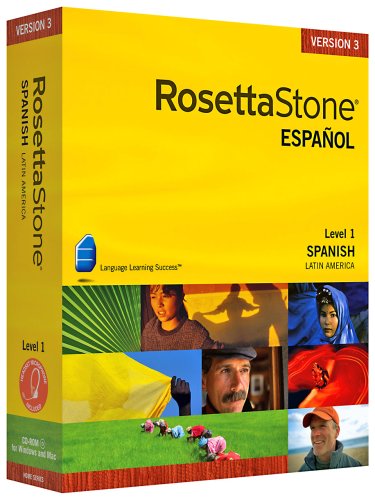
 Why is Rosetta Stone the world's No. 1 language-learning software? Because it works.
 Escape the endless tedium of translation, memorization, and grammar drills. Get the language you want, the skills you need and the success you deserve by learning a new language naturally--the same way you learned your first language.
 |  | |
 The complete immersion environment puts your native language-learning skills to work, eliminating your dependence on tedious translation and rote memorization. | | |
 |  |
| | |||
 Images Images |  |  Intuition Intuition | ||
| ||||
In Rosetta Stone you learn the meaning of new language from clear, real-life images.
In this activity you learn colors. | | You advance using language you've learned and clues from new images. That's your intuition at work.
Now that you know colors, you can easily grasp the meaning of the new words... | ||
| ||||
 Interactivity Interactivity | |  Instruction Instruction | ||
Throughout Rosetta Stone, you constantly interact with the program to confirm your intuition.
...and then check what you've learned. | | From beginning to end you build systematically toward your language-learning goals, for the most effective and enjoyable instruction anywhere.
And finally, you get the fun of trying your new language in a real-life simulation. Speech recognition shows you exactly how you're doing. | ||
| | |||


You learned your first language without translation.
You learned your first language easily and naturally by connecting words to objects and events around you. With Rosetta Stone, learn a new language the same way: using native speakers and thousands of real-life images to help you think in the new language from the very beginning. Studies show that learning exclusively in the new language, without translation as a crutch, is crucial.
The exclusive Dynamic Immersion method reinforces your natural language-learning skills with award-winning instructional technology. Identify your learning goals, then choose customized courses that take you there.
The timeless immersion method, along with research-based techniques and new technologies, make Rosetta Stone the clear solution to your language-learning needs.
What will you be able to do?
Understand everyday language.
Through Rosetta Stone's proficiency-based listening and reading activities, you'll learn quickly.
Pronounce words correctly.
After practicing with Rosetta Stone's speech recognition and analysis tools, pronunciation will come easily.
Speak without a script.
Contextual Formation makes sure you have the confidence and cues you need to get the words out on the spot.
Spell and write accurately.
You'll build gradually from letters to words and sentences.
Engage in real-life conversations.
With Milestone activities, gain confidence using speech alone in simulated situations.
Retain what you learn.
The unique Adaptive Recall reinforces language so it sticks with you in the real world.
Customer Review: Very Simple to Use
Rosetta Stone is very simple to use. However having a Spanish book, or obviously a native speaker to supplement the software would make it much more effective. This is because of being tossed directly into the language without a clear translation leaves the door open for some confusion. Overall a great interactive product that is a strong foundation to start learning a new langauge.
Customer Review: YOU NEED TO KNOW THIS
You cannot legally sell this software when you are done with it. They threatened to sue me when I did - they said I had not bought the software, but a license for the software and it was nontransferrable - that I did not have the right to even GIVE it away.
There are many famous instances of immortal musicians being insulted by other famous musicians.
Johann Sebastian Bach, like most musicians of the day, worked as a church musician. He was anything but docile, and was known to rankle easily.
He was once reproved for playing "strange harmonies" during a church service. Bach's answer was to play even stranger harmonies the next Sunday, and this from the greatest composer of religious music the world has ever seen, the composer of the St. Matthew Passion.
Still steaming, the elders complained again to Bach and added the insult that the music was at some points "too long."
The next Sunday, of course, the music was much too short.
Beethoven also had his feuds, especially in the early years when he was establishing himself as a great pianist.
A worthless popinjay named Steibelt had made it known that he thought Beethoven a terrible pianist, and in essence challenged Beethoven to a musical duel, a common occurrence in those days. Beethoven despised Steibelt, for he was in truth a talentless oaf that foolishly dared to challenge a great master.
At a party the next week, Beethoven heard Steibelt playing one of his own compositions, an insipid Trio for piano, violin and cello. It was the type of horrid, elaborately ornamented fluff that Beethoven reviled, but he watched calmly as Steibelt finished the piece and took his bows.
A hush fell over the crowd as Beethoven appeared out of the shadows and walked toward the piano. Everyone was aware of the grudge between Steibelt and Beethoven and the air was thick with apprehension.
Steibelt, startled by the angry look on the master's face, stepped away from the piano.
As Beethoven walked past the cello's music stand, he snidely grabbed the cello's sheet music.
Carefully showing the astounded crowd the page of sheet music, Beethoven sat at the piano and then put the music, upside down, onto the piano music stand.
As Steibelt and the hushed crowd watched, Beethoven plunked out the notes of the upside down cello part, forcefully jabbing with his pointed and angry index finger, not taking his eyes off Steibelt.
Then Ludwig began to improvise like a madman on Steibelt's upside down cello part theme. The crowd was carried away with Beethoven's angered showmanship.
And it was magnificent, one of those legendary Beethoven improvisations that have gone down in history, a passionate outpouring of ideas and bravura, until at last the piece was over with a furious ending and crash.
Curiously, Steibelt was never heard from again.
By John Aschenbrenner Copyright 2000 Walden Pond Press. Visit http://www.pianoiseasy.com to see the fun PIANO BY NUMBER method for kids.
John Aschenbrenner is a leading children's music educator and book publisher, and the author of numerous fun piano method books in the series PIANO BY NUMBER for kids. You can see the PIANO BY NUMBER series of books at http://www.pianoiseasy.com
latin download
No comments:
Post a Comment