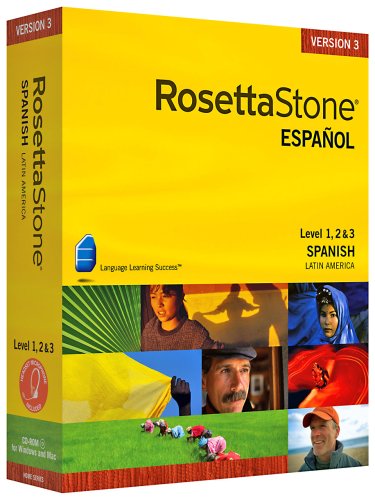
 Why is Rosetta Stone the world's No. 1 language-learning software? Because it works.
 Escape the endless tedium of translation, memorization, and grammar drills. Get the language you want, the skills you need and the success you deserve by learning a new language naturally--the same way you learned your first language.
You learned your first language without translation.
You learned your first language easily and naturally by connecting words to objects and events around you. With Rosetta Stone, learn a new language the same way: using native speakers and thousands of real-life images to help you think in the new language from the very beginning. Studies show that learning exclusively in the new language, without translation as a crutch, is crucial.
The exclusive Dynamic Immersion method reinforces your natural language-learning skills with award-winning instructional technology. Identify your learning goals, then choose customized courses that take you there.
 |  | |
 The complete immersion environment puts your native language-learning skills to work, eliminating your dependence on tedious translation and rote memorization. | | |
 |  |
| | |||
 Images Images |  |  Intuition Intuition | ||
| ||||
In Rosetta Stone you learn the meaning of new language from clear, real-life images.
In this activity you learn colors. | | You advance using language you've learned and clues from new images. That's your intuition at work.
Now that you know colors, you can easily grasp the meaning of the new words... | ||
| ||||
 Interactivity Interactivity | |  Instruction Instruction | ||
Throughout Rosetta Stone, you constantly interact with the program to confirm your intuition.
...and then check what you've learned. | | From beginning to end you build systematically toward your language-learning goals, for the most effective and enjoyable instruction anywhere.
And finally, you get the fun of trying your new language in a real-life simulation. Speech recognition shows you exactly how you're doing. | ||
| | |||


The timeless immersion method, along with research-based techniques and new technologies, make Rosetta Stone the clear solution to your language-learning needs.
What will you be able to do?
Understand everyday language.
Through Rosetta Stone's proficiency-based listening and reading activities, you'll learn quickly.
Pronounce words correctly.
After practicing with Rosetta Stone's speech recognition and analysis tools, pronunciation will come easily.
Speak without a script.
Contextual Formation makes sure you have the confidence and cues you need to get the words out on the spot.
Spell and write accurately.
You'll build gradually from letters to words and sentences.
Engage in real-life conversations.
With Milestone activities, gain confidence using speech alone in simulated situations.
Retain what you learn.
The unique Adaptive Recall reinforces language so it sticks with you in the real world.
Customer Review: Rosetta Stone V3-Spanish (Latin America) Level 1,2,3
I purchased this for my college-aged daughter so that she could become proficient in Spanish. This has given her the practice she needs that the classroom (high school) did not.
Customer Review: Great Addition to School Learned Spanish
I took 17 hours of Spanish during my undergraduate degree, but could not speak Spanish. I could read Spanish, but I could not understand it when spoken. Rosetta Stone takes a different approach to teaching Spanish than my university. It has made understanding and speaking Spanish within my reach. I had a strong vocabulary base, but Rosetta Stone has helped me to be able to speak and use this vocabulary in everyday conversation. This is a great complement to any Spanish curriculum. It is a wonderful option for those who couldn't learn Spanish "the old fashion way."
Origin:
Mambo originated in Havana, Cuba in the 40s. The Mambo was originally played as a Rumba with an emphasis on 2 or 4. Once introduced, it fast led to other variations. Although Mambo did not last long and is only danced by advanced dancers today, it led to other styles that became popular such as Salsa and Cha-cha.
Music:
Mambo is an up-tempo dance rythm, usually around 200 bpm. Mambo, like Salsa is played in 4/4 with all 4 beats being evenly accented. Like a lot of Latin American rythms, percussion forms a very important part of the music.
Dance:
Mambo is probably one of the toughest dances to learn, especially is you are already used to dancing one of the other Latin styles like Salsa. Although the music is 4/4, the stepping is quite different. The steps are taken on the second beat as opposed to the first beat, which is one of the main differences that throw most dancers off. The other difference is that the weight change takes place three times in every four beats whereas only two steps are taken!
Latinos NZ Popularity Scale: 1/10
Mambo is rarely danced in Latin clubs in New Zealand, and is rarely taught in training institutes.
Article taken from Latinos.co.nz (http://www.latinos.co.nz)
latin cds
No comments:
Post a Comment